Alaskan Brown Bears with Kristoff Druva Wildlife
Lake Clark National Park | August 24-27, 2026
A Personal Review
Quick note before we start
This review is based on my personal experience, and someone else’s experience may look completely different. I review workshops and guided trips through the lens of my framework and criteria, which you can read here:
👉 https://www.mywildlifechronicles.com/journal/how-i-review-photography-workshops-and-the-framework-i-use
If you’re curious why I do workshops and why I review them, you can read that here:
👉 https://www.mywildlifechronicles.com/journal/why-i-do-photography-workshops-and-review-them
At a Glance
With: Kristoff Druva - https://kristoffdruvaphotography.com
Type: Guided photography trip
Primary subject: Brown Bears
Accommodations included?: Yes
Food included?: Yes
Group size: 4 participants
Shooting schedule: Golden hour, blue hour, and a little mid-day
Physical demands: Moderate
Overall feel: A unique experience with a fun and knowledgeable guide
Best fit for: Photographers who want to experience Alaskan brown bears from a remote beach camp rather than a traditional wildlife lodge
Where this was
This guided photography trip took place in stunning Lake Clark National Park. Established by Congress in 1980, Lake Clark spans more than 4 million acres, with roughly 65% protected as wilderness. Glaciers, alpine tundra, salmon-filled rivers, and two active volcanoes, Mount Redoubt and Mount Iliamna, create one of Alaska's most dramatic landscapes. Add in brown bears in hyperphagia, and you have the recipe for an amazing wildlife photography trip!
There are no roads into Lake Clark National Park, so access is limited to boat or plane. Simply getting there to photograph brown bears with Kristoff was an adventure in itself. From Spokane, I flew to Anchorage and rented a car for the drive to Soldotna (about 3.5 hours from the Anchorage airport), where our group would meet the next day and board a small bush plane for the flight across Cook Inlet to our final destination.
Because there was no way to fly from Spokane and make it to Soldotna in time to catch the bush plane, I spent the night in Cooper’s Landing (about an hour from Soldotna) and took the opportunity to visit the Skilak Wildlife Recreation Area, a state-managed wildlife area on the Kenai Peninsula.
The bush plane ride from Soldotna to ground zero for bear heaven was less than an hour and, to be frank, almost more than I could wrap my head around. The views from above were incredible. Glaciers, stunning teal lakes, and wilderness as far as the eye could see. It was hard to believe a place like this still exists. It was simply amazing.
Our experienced bush pilot landed with ease on the beach where we would be spending the next four days. He pulled up right beside our tents as Kristoff waved enthusiastically from camp.
Sleeping in tents in bear country, I thought to myself as I unloaded my gear. Yikes! I hope I've made a safe decision. I guess there's no turning back now!
Why I chose this trip
I did my first wildlife photography workshop in July 2025 (read about it here), and there has been no looking back since. I absolutely love them!
One thing I've learned is that many workshops and guided photography trips book well in advance, sometimes more than a year ahead. If the leader has a good reputation and the participant count is low and manageable, you have to stay on your toes because those spots disappear quickly.
By October 2025, I had already put down deposits on three workshops for the following year and thought my calendar was pretty much set. But after photographing grizzly bears at Klahoose Wilderness Resort the month before (read about it here), I found myself wanting more time with those big, beautiful, and incredibly photogenic bears.
The problem was cost. At the time, I simply couldn't justify the prices some of the Alaska lodges were charging. As I started looking for alternatives, I discovered that there were guides experienced in bear behavior and safety who led photography-focused camping trips in areas where brown bears are especially active during hyperphagia.
Now we were talking.
During my research, I came across Kristoff's Alaskan brown bear camping experience and was immediately intrigued. We exchanged messages for several days while I peppered him with questions about the trip, what a typical day looked like, and, most importantly, safety. Eventually, we scheduled a Zoom call so I could really dig into his approach and get comfortable with the idea of camping in bear country with him.
He answered every question thoughtfully, addressed my concerns, and came across as a genuinely great guy.
So I booked the trip.
Much to my husband Trevor’s dismay...
Workshop vs Guided Trip, and How That Shaped the Experience
Before I talk specifically about this trip, it's important to explain how I view workshops versus guided photography trips, because they aren't the same to me. When I sign up for a workshop, I'm not just looking for someone to get me in front of wildlife. I'm looking for someone who can help me become a better photographer. I expect teaching, feedback, and support in addition to access to great subjects. A guided photography trip may offer amazing wildlife access, but a workshop should also provide intentional and obvious learning opportunities. One isn't better than the other. They're different, and the expectations should be different too.
Kristoff's trip was most definitely a guided photography experience. That's critically important for this trip, in my opinion. If you're considering a trip with only one leader and you'll be spending your days around apex predators, frequently lying on the ground to get eye-level images, you should hope that person is more focused on your safety and the bears' safety than on making sure you're using the right shutter speed.
While this wasn't what I would define as a workshop, Kristoff did a great job sharing photography nuggets along the way and ensuring we were positioned with great backgrounds when possible. More importantly, he did an outstanding job paying attention to where each bear was, reading bear behavior, and making sure everyone in the group stayed safe while minimizing our impact on the bears.
Ethics and Safety
Kristoff was very conscientious that our group moved and acted in a way that did not disturb the bears. Did the bears know that we were there? Of course they did. Did we move slowly and stay as tight as possible so the bears wouldn't feel threatened or go on alert? Yep. And his approach to how we behaved stayed true from the beginning to the end. There was no bear chasing or getting unnecessarily or uncomfortably close. We found a spot each outing that gave the bears the space they needed to keep feeding in preparation for hibernation, and he ensured we didn't separate as a group. He was clear about the decisions he was making for us and why. It wasn’t just for our safety. It was the right thing to do for the bears.
After a day of explanation, it was clear that not every leader shared the same philosophy. We watched groups come and go throughout the week, and some had participants wandering off on their own. Kristoff expected us to stay together as a group, and after spending time around these bears, it was easy to understand why.
I felt lucky to have Kristoff as a guide because I can really get lost in the moment when I'm shooting. I always felt Kristoff had our backs and was paying attention to everything happening around us, which let me focus on photography knowing safety was being taken seriously.
Time of Day and Light
Both sunrise and sunset shooting were a priority each day. We would stay at Bear Central until the light became too harsh in the middle of the morning. In the evenings, we stayed through sunset and often into blue hour before heading back to camp. Since sunset in Alaska during late August was around 9:30 p.m., we sometimes didn't make it back to our home away from home until 10:30 p.m. or later. I have a series of images taken around 11:00 p.m., so don't expect early nights!
We got one morning with a gorgeous sunrise, but most mornings were overcast, which, honestly, I am beginning to prefer. If the sun rose with beautiful colors and interesting cloud structure and then turned overcast after that, I would be in heaven. Wishful thinking, indeed.
The afternoons were downtime used for downloading photos, napping, or the occasional short hike. We did very little shooting during the middle of the day.
Physical Requirements and Gear
I don’t normally give physical requirements and gear their own dedicated section, but for this trip, I would be remiss if I didn’t. I am the type of customer who reads every piece of literature about a trip at least 10 times and, yes, I buy all the recommended gear. Kristoff states clearly in his FAQs for the trip that you must be able to walk up to 10 miles a day with your gear, and he also recommends hip or chest waders.
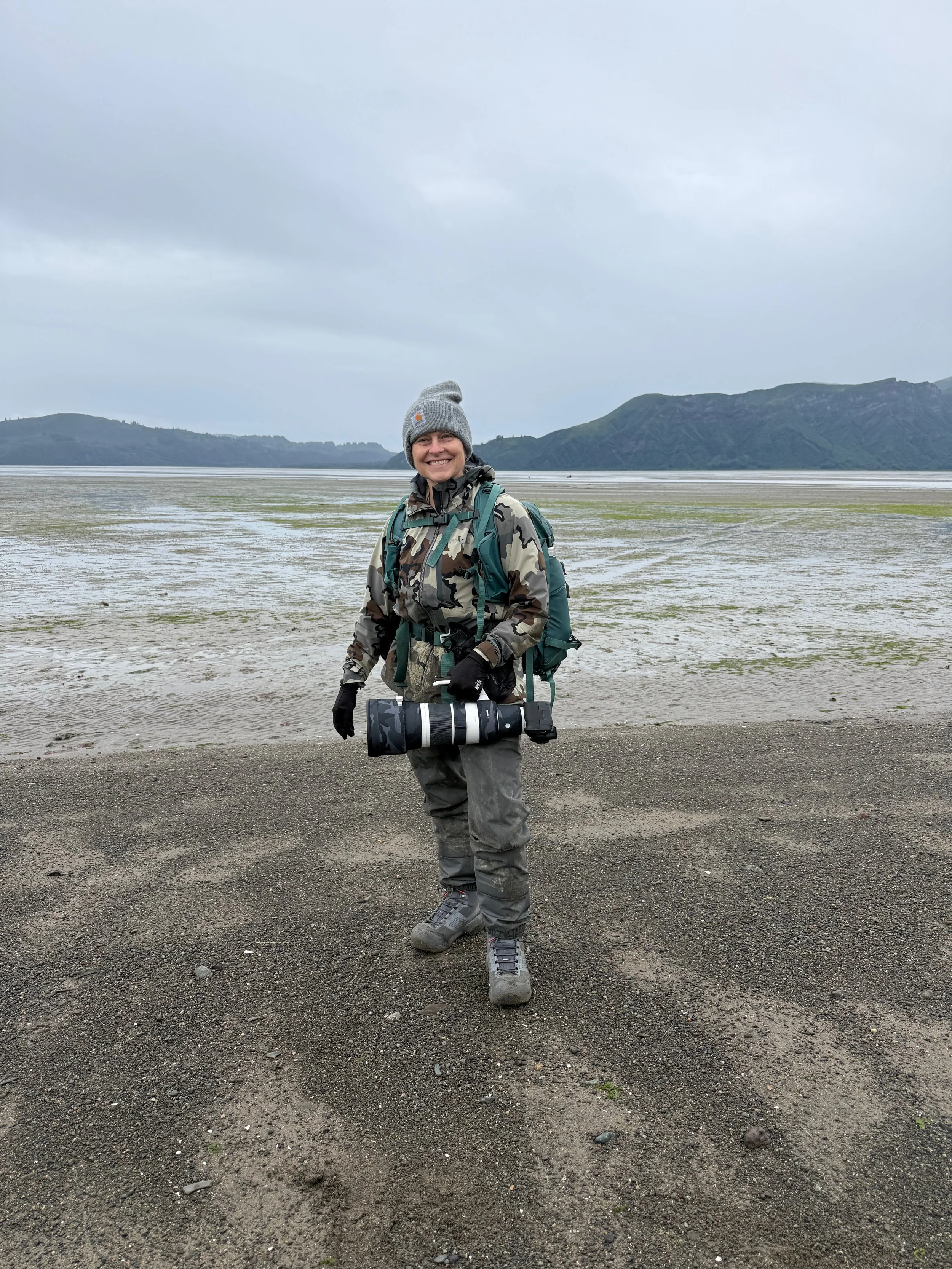
I sincerely thought both the 10 miles a day and the waders were worst-case-scenario stuff. Ummm…that is a no.
We trudged out to the shooting location twice a day in our waders, with each walk being between 1.5 and 2 miles, depending on where the bears were hanging out. And we did that twice a day. A short hike mid-day, and we recorded 10 miles one day. You need to carry all the equipment you want for that sesh, too. That said, the bears just happened to frequent an area that wasn't close to camp. Kristoff said he had been there before when the bears were hanging out a quarter of a mile away. Admittedly, I loved the exercise and the fact that the bears were a little farther from camp. But that is just me.
Now for the waders. Yes. Buy the waders. You are hanging out in dirty, sticky, wet mud flats. I decided to buy Simms chest waders, and I am so grateful I did, since I am a prone shooter and didn't let the mud flats stop me from throwing myself on the ground. I also brought a sturdy Kuiu rain jacket to go over my chest waders. The duo worked well, but I definitely put the rain jacket to the test. I could barely zip it up by the end of the trip as there was so much gunk in the zipper. It ultimately cleaned up just fine when I got home.
The physical requirements are real. Do not skimp on the waders.
Accommodations and Food
Accommodations were included in the cost of this adventure, and they were exactly what you would expect from a camping-style bear photography trip. Kristoff provided the tents and sleeping pads and, not going to lie, the sleeping pads he chose were pretty darn comfortable. We were responsible for bringing our own sleeping bags.
The camp was located right off the beach, which meant sand in the tent and just about everywhere else it could work its way into. It simply came with the territory. By the end of each day, I was so exhausted that the sand was only a minor nuisance as I slid into my mummy sleeping bag, which kept me nice and cozy during the chilly 40-45 degree nights.
Believe it or not, Kristoff didn't hire a personal chef for this excursion, but he treated us to freeze-dried backpacking meals he enthusiastically prepared multiple times a day. He went the extra mile before the trip, making sure he understood everyone's food allergies and sensitivities and spending what I assume were hours reading labels and ensuring we had a large selection of meals to choose from.
He also made coffee for us every morning, which was incredibly welcome, as I swear I could see my breath one morning! All food was stored in bear-resistant containers and handled with bear safety in mind.
Keep in mind that mosquitoes and other pesky bugs are still plentiful during August in Alaska, but we kept our tents buttoned up tight, and Kristoff turned on the Thermacell whenever we were in camp, which seemed to help quite a bit. Before this trip, I had never heard of a Thermacell. Kristoff recommended that we look into getting personal Thermacells, and since they weren't too terribly expensive, I decided to invest. I was very happy that I did. I can see myself using mine quite a bit on future hikes during mosquito season in the ol' PNW.
The camp was surrounded by an electric bear fence, which was somewhat reassuring and also a requirement for camping in this type of environment. We didn't see many bears near camp, but I was very thankful that it was there. We each carried bear spray at all times, and Kristoff also carried flares. Thankfully, we never found ourselves in a situation where either was needed, but it was always within arm's reach.
Cell service was essentially non-existent for me there, but Kristoff provided Starlink at the camp so we were able to call home and check in with loved ones multiple times per day if we chose to. Since Trevor was certain I was going to get eaten by a brown bear, this added perk was comforting for both him and me.
Overall, Kristoff did a great job ensuring that we felt as comfortable, well fed, and as safe as possible, considering we were camping in bear country.
Group Size and How It Affected the Experience
This was definitely a small-group experience. There were five of us in total, including Kristoff. It was an easy-sized group to manage and helped minimize the footprint we were making. We saw other groups come through during the week, some of which had what looked to be at least ten participants. I was very thankful that we were a small and compact group.

Kristoff advertised this as a three-participant trip, which was something I really liked. However, he allowed a fourth participant to join this particular week because the three of them were friends who had traveled and photographed together before.
I would be lying if I said I didn't feel a little like an outsider at first. One of the things I enjoy most about these trips is getting to know everyone, and usually we're all starting from ground zero together. This trip was a little different since I was the only participant who didn't already know everyone else. That said, they were all very nice and went out of their way to include me in their pre-trip exploring around Cooper’s Landing. I appreciated that.
Overall, the group size was great, and the people were awesome!
Communication, Logistics and Feeling Cared For
Each trip leader has very different communication styles. Some are very thorough with pre-trip PDFs, answering every question under the sun. A few struggle to communicate promptly. Some set up a WhatsApp group, and others don’t. I will say that the trips that communicate via WhatsApp before and, especially, during the trip tend to go much smoother. That said, WhatsApp would have been useless during this trip, as we had no reception and remained a unit the entire time.
Before the trip, Kristoff did an outstanding job returning messages and emails promptly, and his responses to questions were thorough. I always knew where to be and when, and I didn't feel there were any lingering, unanswered questions. When it comes down to it, of all the trips I have been on in the last year and a half, Kristoff was the quickest responder pre-trip. I liked that a lot, since I am a pre-trip question-asker! Even post-trip, Kristoff has been encouraging and friendly, and I can tell he is genuinely excited to see the photos I took.
Feeling cared for is incredibly important to me on these trips, and there is no doubt Kristoff wanted to make sure we had everything we needed and felt taken care of. Of course, this has to be within reason considering we were camping and living out of Yeti coolers that had to be flown in. No...you're not going to be taken care of the same way you would be at a $12,000 lodge. But we had what we needed, and Kristoff was happy to get it for us!
This wasn't luxury travel, but Kristoff genuinely cared about the participant experience.
Reflection
When I signed up for this trip, I just wanted to spend time photographing Alaskan brown bears without paying lodge prices. What I found was much more than that.
I found a guide who took safety seriously, respected the bears, communicated exceptionally well, and genuinely cared about the participant experience.
This trip won't be for everyone. If you're looking for gourmet meals, private rooms, and luxury accommodations, this probably isn't your trip. If you're uncomfortable walking 8-10 miles a day in waders or sleeping in a tent in bear country, this probably isn't your trip either.
But if you're looking for an immersive experience in one of Alaska's most spectacular landscapes, and you don't mind trading a few creature comforts for more time with bears, this trip deserves serious consideration.
I came home with images I'm proud of, memories I'll never forget, and an experience that was unlike anything else I've done as a new wildlife photographer.
Would I do it again?
Absolutely.
A few shots from my time in Lake Clark National Park with Kristoff Druva:
Read my workshop review framework: https://www.mywildlifechronicles.com/journal/how-i-review-photography-workshops-and-the-framework-i-use
Read why I do workshops and why I review them: https://www.mywildlifechronicles.com/journal/why-i-do-photography-workshops-and-review-them