A moment in time with these ancient birds
For about two to three weeks in March and April, migrating Sandhill Cranes make a stop in West Richland, Washington. Most of the cranes moving through are heading north from their wintering grounds in California and on to breeding areas in Alaska and northern Canada. West Richland becomes a place to stop briefly, refuel, rest, and then head out again.
Depending on where they start, this journey from California to Alaska can be thousands of miles and can take weeks to complete. And then they do it all again in the fall.
Sandhill Cranes are one of the oldest bird lineages, with fossils dating back millions of years. It’s kind of wild to be standing there watching birds that have been doing this long before humans were around.
Sandhill cranes call to their flock at Barker Ranch in West Richland
At a Glance
Location: West Richland, Washington
Primary subjects: Sandhill Cranes
Seasonality: March/April, spring
Time of day: Early morning and evening
Access style: Roadside, no hiking or walking
Physical demands: Low
Overall feel: Overwhelming but unpredictable, visually busy for shooting
What This Place Is
In my research before heading out, it seemed like there were a few places you might find cranes during this time of the year in West Richland, but there was a pretty clear consensus on THE place to go. Barker Ranch was it.
Barker Ranch runs along the Yakima River, with open agricultural fields stretching toward the road. When I was there, the nearest field had been cut, creating a wide, open space where sandhill cranes often stop to gather. The land is private property, clearly signed, but the road itself allows for quiet observation and changing views as you move through the area.
There’s a fence running the length of the field, which I wasn’t really expecting, but it makes sense given how many people show up during crane season. I worked around it and even used it for stability a few times.
The background is very much a working agricultural landscape. Chopped corn stalks, farm equipment, and fencing are all part of the scene. There are distant hills and a line of leafless trees along the horizon that help a bit with environmental shots.
When I was there (March 7–9, 2026), there were very few people. I had the place to myself more than once. It could have been because it was a little early in their stopover window, but I was still surprised by how quiet it was.
This was my first visit, and it was during spring migration. From what I understand, cranes also pass through in the fall, but the timing and their concentration can vary.
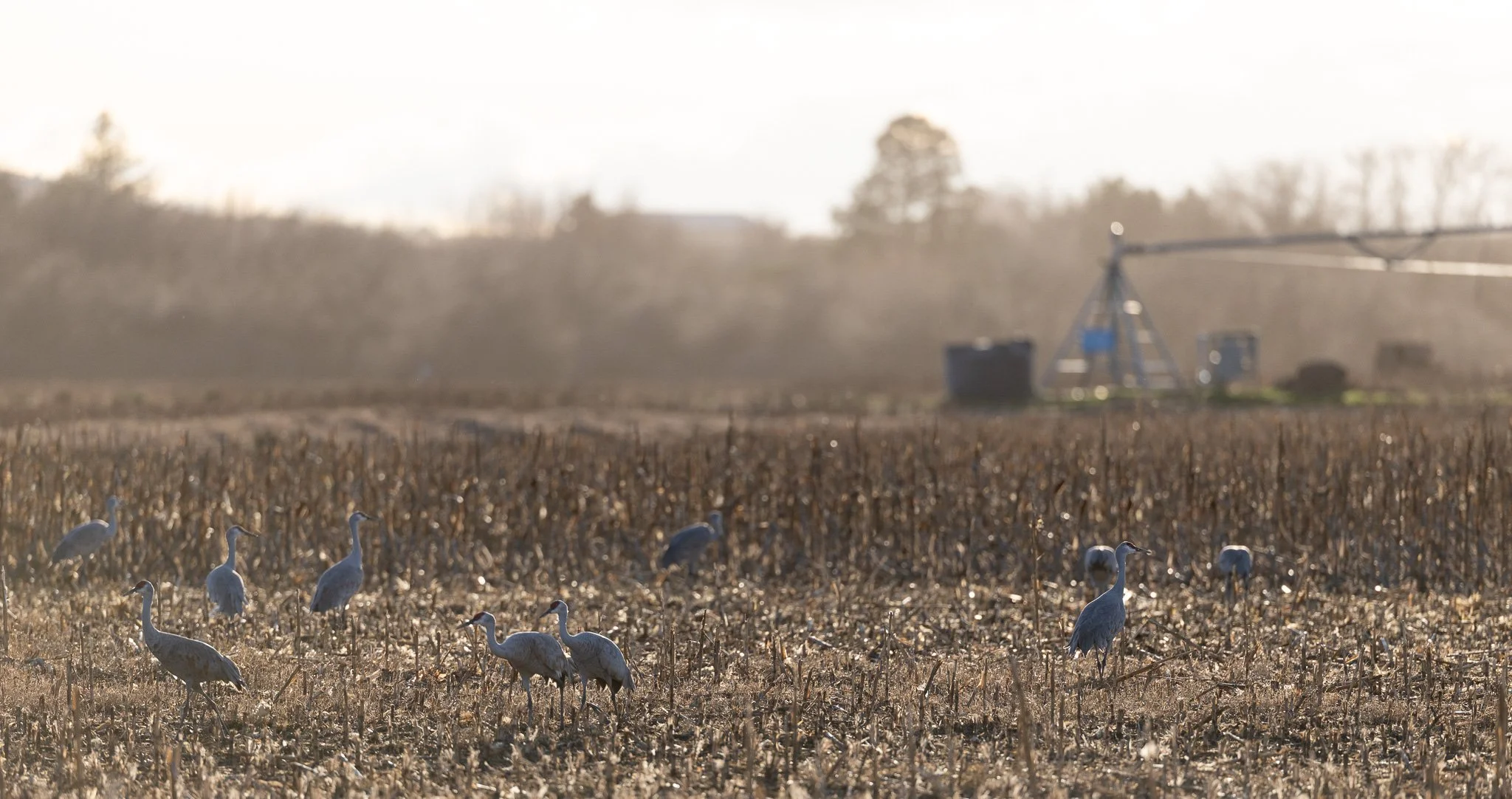
The field that the sandhills congregate on is a working field so you will need to work around the equipment for environmental shots.
Why I Was Drawn To Go
I’d wanted to see the Sandhill Cranes in West Richland ever since I saw posts in our local birding Facebook group, Spokane Birders, last year. At the time, I didn’t realize how short the window was in the spring. By the time I talked to Trevor about going, they were already gone.
I was bummed, but I promised myself I’d make it happen this year, and I did.
Back then, I was also struggling to find many birds in my area, so the idea of seeing a large group of them in one place really grabbed me. Plus, cranes are just cool-ass birds.
Wildlife Observations
I visited Barker Ranch four times over two days, two early mornings and two evenings. This feels important to say: there was not a single time I showed up and found cranes already standing in the field.
Out of those four visits, cranes landed in the field only twice, both times in the evening. In the mornings, I could see them flying and hear them calling, but I waited for hours, and they never came down.
Sandhill cranes showing up for the evening.
In the evenings, they started to show up about half an hour before golden hour. When they did arrive, it happened fast. One or two would land, and then suddenly there were dozens, sometimes close to a hundred, standing out there.
There was a lot of interaction between them. It felt like there was always some kind of small altercation going on, cranes defending space or food. If that kind of behavior is what you’re hoping to see or photograph, you’ll find plenty of it.
There were also lots of opportunities for birds in flight. They signal well in advance when they’re coming in, and their approach is slow and predictable. They often arrived in pairs or small groups, but larger groups weren’t unusual either.
They are not quiet birds. They call to each other often, and I found myself really liking the sound of it. Sometimes it felt almost conversational.
Overall, it was fun to watch their behavior, even from behind a fence.
Never short on drama with a flock of sandhill cranes!
Light and Atmosphere
One of the really nice things about this location is the light. Sunrise is behind you when you’re facing the field, and the sun sets beyond the field.
On my first evening there, the sunset was incredible. Reds, oranges, and yellows made for some really striking silhouettes. The second evening wasn’t boring, just not as dramatic.
The first morning, even though no cranes landed in the field, the sunrise was unreal. Pink, fluffy clouds with a warm glow. I used the opportunity to photograph cranes flying over the horizon with the sky as the main subject. The second morning was pretty blah in comparison.
If you show up at the right time of day and the birds cooperate, the light here can be really good.
Barker Ranch at sunrise.
Barker Ranch at sunset.
Access and Practical Context
This is roadside shooting. The fence keeps you back from the field, and there’s a berm between the fence and the field that affects how low you can get.
I like shooting prone sometimes, and that just isn’t possible here. If shooting prone is important to you, this location will be limiting.
The ground is easy to navigate, and you’re walking along a gravel road. I didn’t use a tripod, but there’s room if you want one. I mostly used a fence post for stability when needed.
Parking was easy when I was there (plenty of room to pull off the gravel road), but I could see this getting crowded during peak weekends.
Because of the fence, getting too close to the cranes isn’t really an option, which I appreciated. The setup naturally keeps people at a respectful distance.
Gear Notes
I shot with my Canon R5 Mark II and the RF 100–300 f/2.8, using my 1.4x extender about 25% of the time. I didn’t use a tripod or monopod. The fast aperture helped a lot in the evenings, and I was glad to have the flexibility of a zoom.
I had my RF 100–500mm with me and my RF 14-35mm, but never took either of them out.
When This Place Is Hard
As cool as it was when the cranes showed up, this location isn’t ideal for my usual shooting style.
The background is busy, with chopped stalks, farm textures, and equipment. With so many cranes in one place, isolating a single bird for a quiet portrait is difficult. The fence and berm limit angles, and there’s no way to move into the field to simplify things.
It can also be very windy. One day was especially rough, and holding a long glass in that wind made it even more challenging.
Wildlife photography often requires adapting to what a place allows, and this location was no exception. I shifted to working with more distant, environmental compositions and focused on structure and balance instead. It ended up being a blast, and I learned a ton!
A flock of sandhill cranes flying over the top of windblown shrubs.
Not Just Sandhill Cranes
Barker Ranch isn’t only a stopover for sandhill cranes. During my visit, hundreds of waterfowl were spread across the surrounding fields, likely mallards, though they never moved close enough to confirm.
About a mile farther down the road, a small pond held a quiet group of swans, adding to the sense that this stretch of the Yakima River corridor supports far more activity than you might notice at first glance. Even brief pauses along the road revealed how layered and active the area really is.
An enormous flock of ducks flying over Barker Ranch.
Trumpeter swans at a small pond down the road.
Reflection and Closing
I have no regrets about spending the weekend in West Richland with the Sandhill Cranes. They were beautiful, animated, and in a unique way, musical. I really loved it.
Was it ideal for my shooting style? No. Did it push me to shoot differently and try new things? Yes. I don’t get many chances to shoot silhouettes, and this turned out to be a great opportunity.
Would I go back? Maybe. If I did, it would be to see how different the scene feels under different conditions, especially if there’s water in the field.
I hope this post is useful if you decide to visit West Richland to experience the Sandhill Cranes. If you do go, I’d love to hear how it goes!
Sanhill cranes at sunset at Barker Ranch, West Richland.